Types of tobacco: the leaf varieties and curing methods, explained
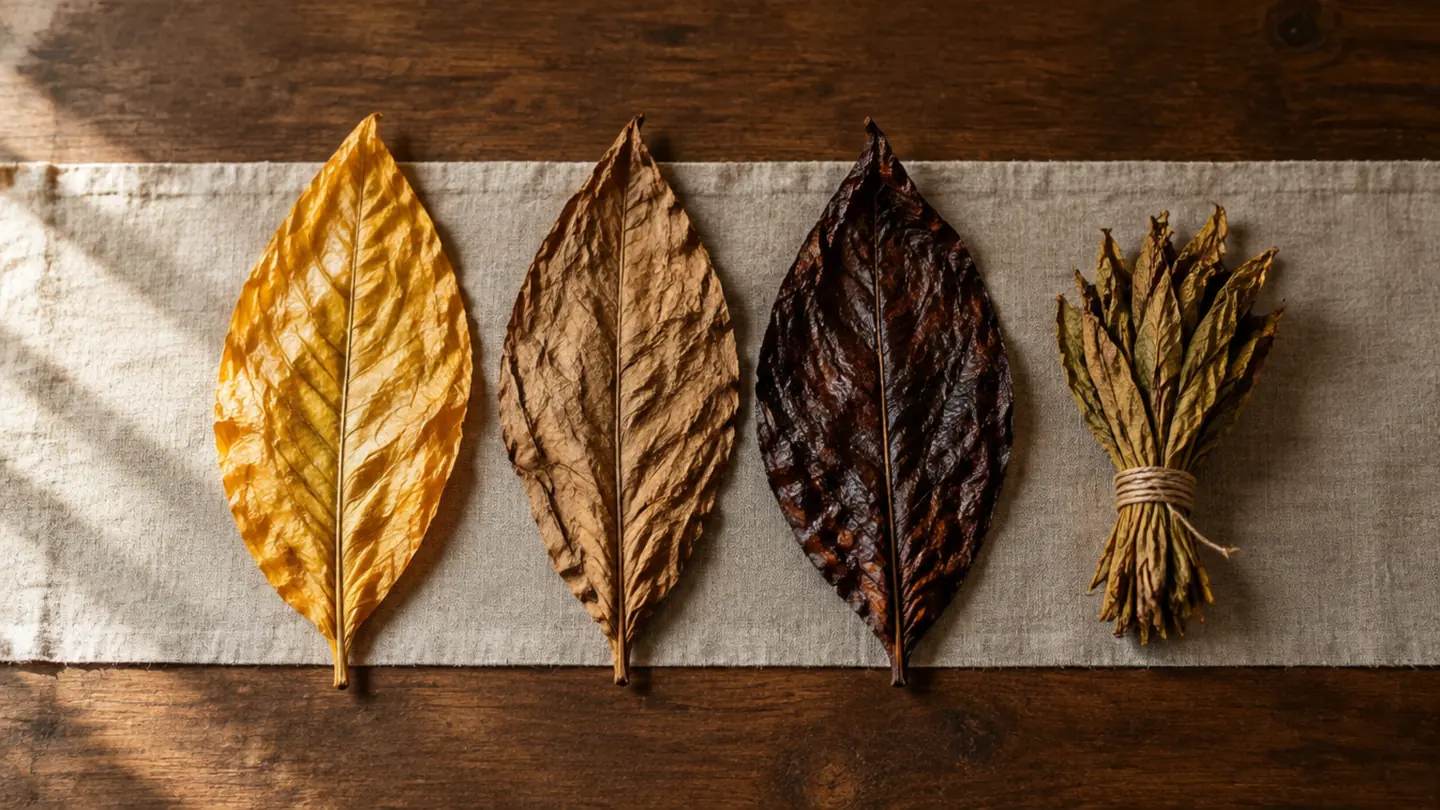
Nearly all commercial tobacco is one species, Nicotiana tabacum. The differences people actually taste, bright and sweet, dry and nutty, dark and smoky, come mostly from what happens after harvest: how the leaf is cured. That is how the U.S. Department of Agriculture sorts American leaf, into flue-cured, fire-cured and air-cured classes. A few famous names, Latakia, Perique and Cavendish, describe an extra process rather than a separate plant.
What decides a tobacco's type
Tobacco comes out of the field green. Whatever it becomes, golden, tan, mahogany or nearly black, it becomes in the days and weeks that follow. Nearly all tobacco grown for sale is a single species, Nicotiana tabacum, so the names a pipe smoker or a cigar buyer uses are mostly names for what the grower did next.
The USDA’s official standards for leaf tobacco say this plainly. The classification in Title 7, section 30.31 of the Code of Federal Regulations sets out nine classes, and the first three are named for the cure: Class 1 is flue-cured, Class 2 fire-cured and Class 3 air-cured. Classes 4 to 6 cover cigar filler, binder and wrapper leaf. Class 7 collects miscellaneous domestic types, and Classes 8 and 9 cover leaf grown abroad.
Inside each class, a type number marks where the leaf grows. Flue-cured types 11a through 14 run from the Virginia and North Carolina Piedmont down to Georgia, Florida and Alabama. Burley is type 31, Maryland is type 32, and Perique, grown in a single Louisiana parish, is type 72. Seed variety, soil and weather all shape a leaf too, but the cure is the step the rulebook leads with.
The four curing methods, side by side
Every cure has the same basic job: take the water out of a living leaf slowly enough that its chemistry changes on the way. What separates the methods is the heat, whether smoke touches the leaf, and how long it takes. Those three choices decide how much of the leaf’s sugar survives.
| Curing method | How the leaf dries | Typical time | What it leaves in the leaf | Where you see it |
|---|---|---|---|---|
| Flue-cured | In a closed barn with regulated heat. The smoke and fumes never touch the leaf. | Days, in heat stages | Bright yellow to orange leaf. Reported 8 to 30 percent sugar. | Virginia (USDA types 11a to 14) |
| Air-cured | Hung in a ventilated barn at outdoor temperature, with no fire. | About four to six weeks | Tan to brown leaf. Reported under 0.2 percent sugar. | Burley (type 31), Maryland (type 32) |
| Fire-cured | Over low fires of hardwood slabs and sawdust, and the smoke reaches the leaf. | About six to seven weeks | Dark brown leaf with smoke in its character. | Dark Kentucky and Tennessee (types 22, 23), Virginia (type 21) |
| Sun-cured | Outdoors, in direct sun. | Set by the sun and the weather | Small, aromatic leaf. Sugar figures vary by source. | Oriental, or Turkish, leaf |
Read the table as a spectrum of sugar. Fast heat locks it in. A slow cure at air temperature lets the leaf use almost all of it. Fire adds something the other methods do not, the smoke itself. The sections below take each leaf in turn.
Prefer to watch? Here is the same comparison in about a minute and a half.
You can also watch it on its own page, with the full transcript and sources.
Virginia, the flue-cured leaf
Flue-cured leaf is what most people picture when they think of bright, golden tobacco, and it is often called bright leaf for that reason. The name comes from the flues that carry heat through the barn. The USDA definition turns on one detail: the heat and ventilation are regulated so that smoke and fumes from the fuel never touch the tobacco.
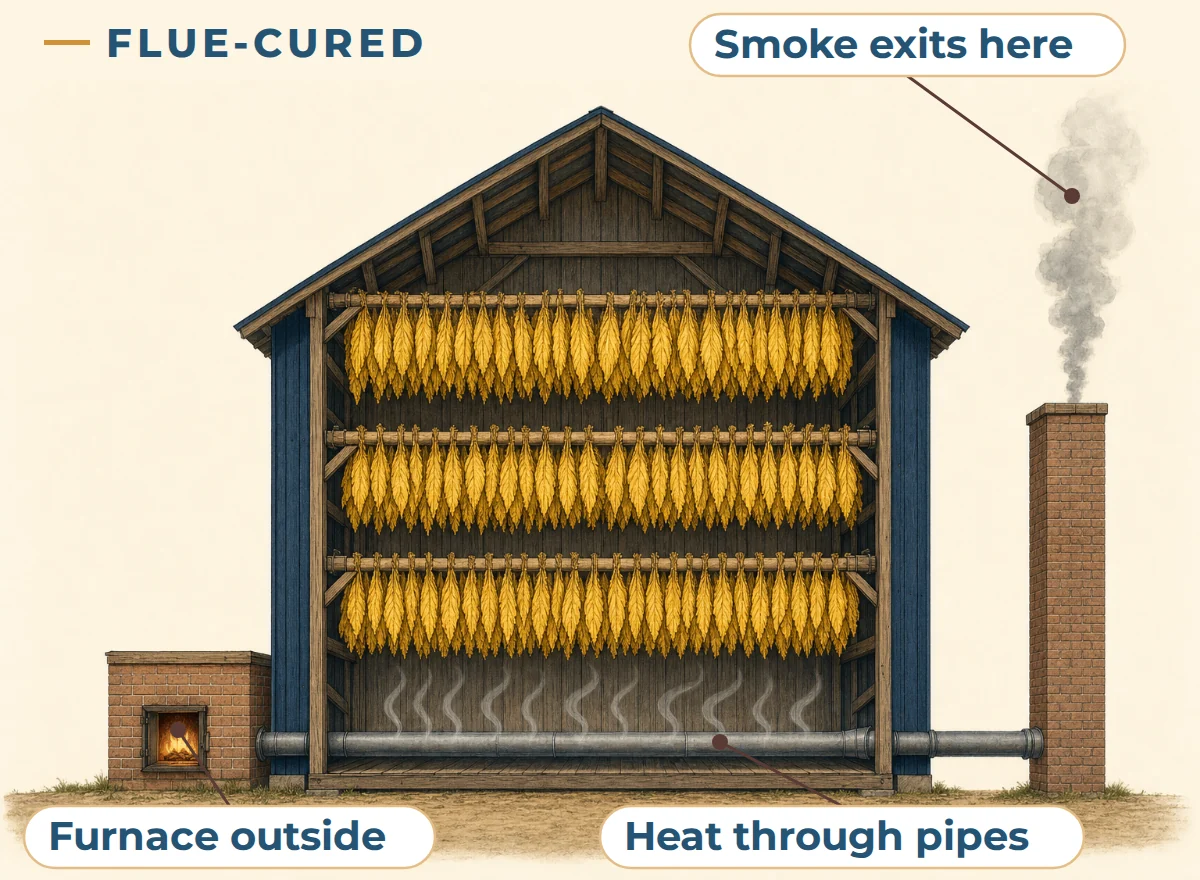
The cure runs in stages. Virginia Tech’s extension guide has growers raise the barn about 2°F an hour to 100°F and hold it there until every leaf has turned yellow. Then the barn climbs to about 130°F to dry the leaf, and finally to about 160°F to dry the thick stems. The leaves have to stay alive through the yellowing stage, because that is when the color and chemical changes happen.
Those changes are why Virginia tastes the way it does. A 2017 review by the FDA’s Center for Tobacco Products explains that the higher temperatures of flue curing quickly shut down the leaf’s own sugar metabolism while starch keeps breaking down into sugar. The review reports sugar levels of 8 to 30 percent in flue-cured Virginia. On the palate that reads as light-bodied, bright and naturally sweet.
Burley and Maryland, the air-cured leaves
Air curing is the patient method. The stalks hang in open, ventilated barns and dry at whatever temperature the season gives them. University of Kentucky guidance describes it as a four- to six-week process, roughly two weeks for the leaf to yellow and two more for it to brown, before the stems finish drying. The USDA definition allows no fire at all, except to prevent pole burn, a form of barn rot, in damp weather.
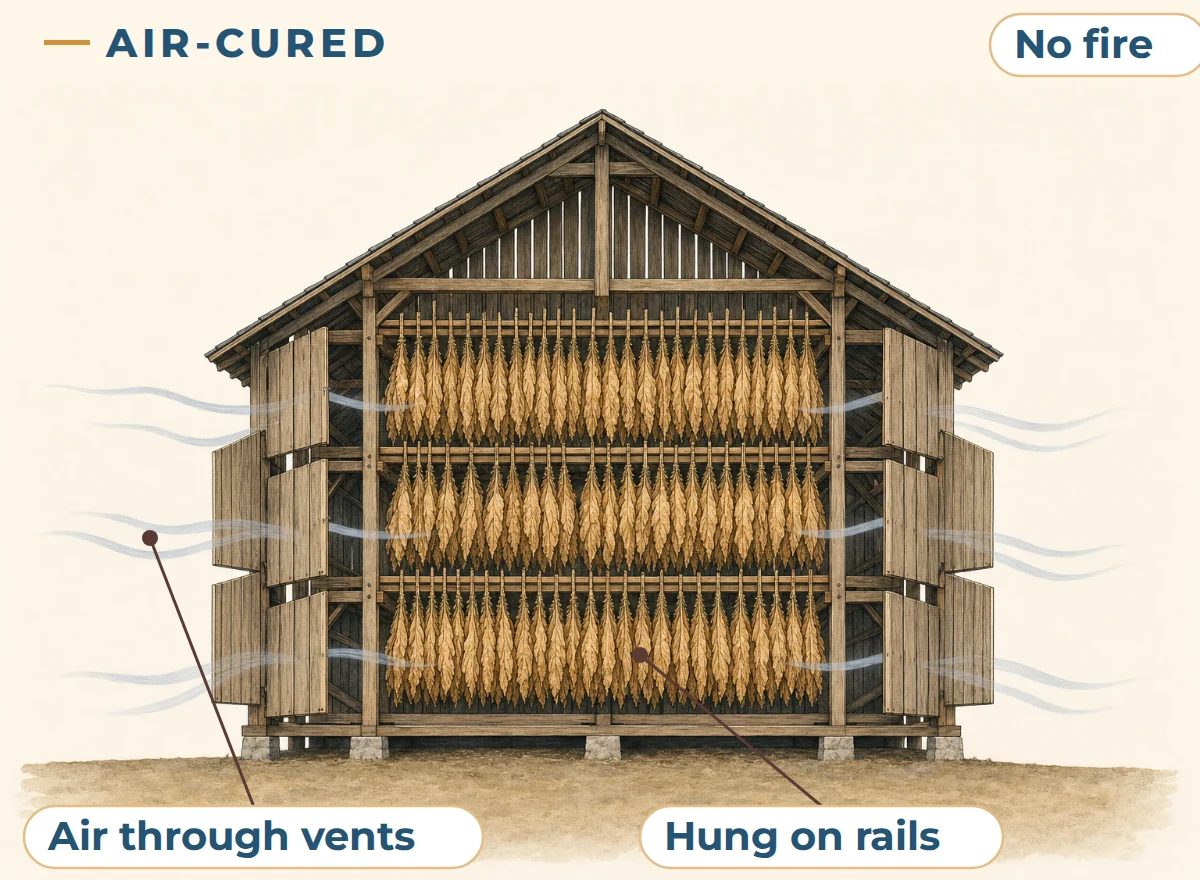
Time is the whole story here. Because the leaf stays alive and slowly dries at air temperature, it spends its sugar. The FDA review puts air-cured Burley at under 0.2 percent. The result is a tan to brown leaf that tastes dry, nutty and full-bodied rather than sweet, the counterweight to Virginia’s brightness.
Burley is USDA type 31, grown principally in Kentucky and Tennessee, with smaller crops from Virginia and North Carolina to Ohio, Indiana, West Virginia and Missouri. Maryland, type 32, is the other light air-cured leaf, grown in southern Maryland. The USDA also recognizes dark air-cured types, 35 through 37, in Tennessee, Kentucky, Indiana and Virginia.
Dark fire-cured Kentucky and Tennessee
Fire curing is the one cure where smoke is part of the recipe. The USDA defines it as curing with open fires whose smoke and fumes are allowed to reach the tobacco.
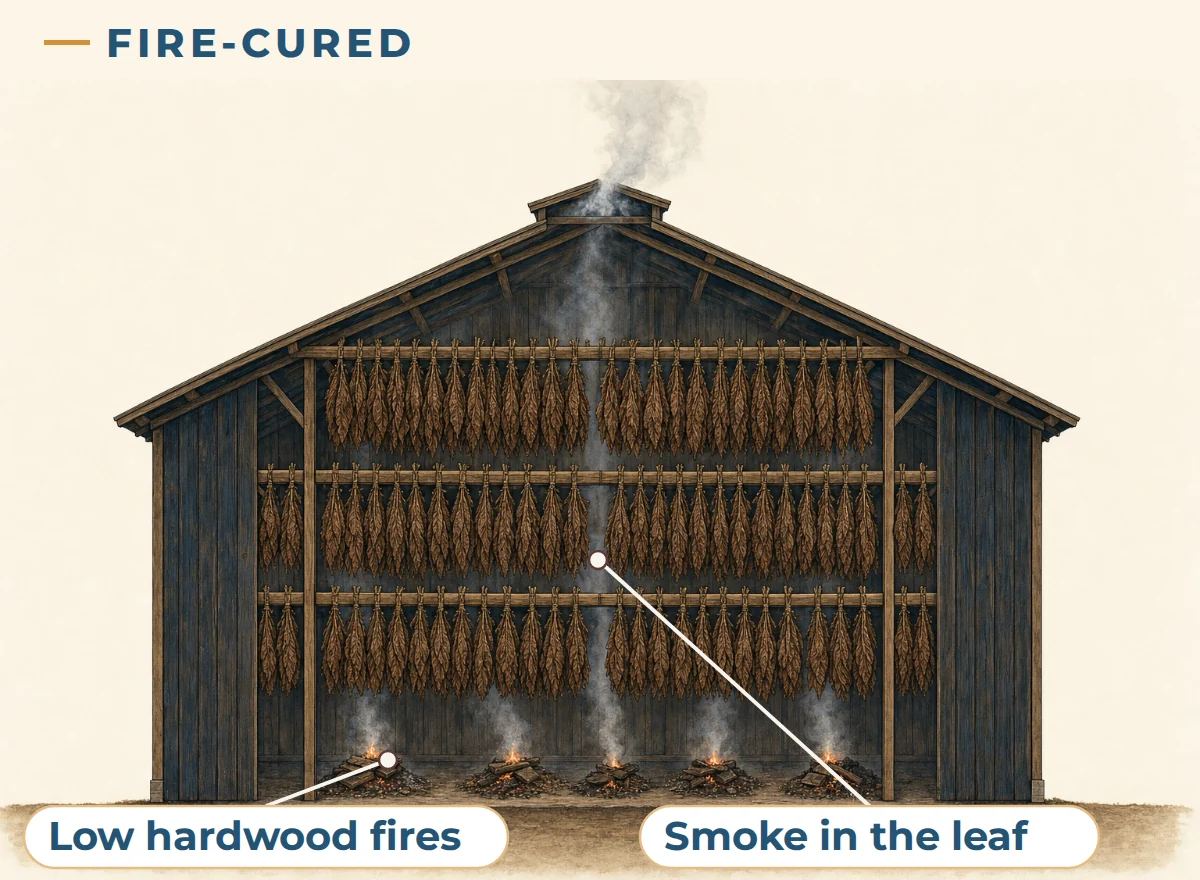
University of Kentucky extension material describes the traditional fuel as hardwood slabs covered with sawdust, laid on the barn floor so they smolder rather than blaze. The final firings are built to throw as much smoke as possible. The whole cure takes about six to seven weeks, and the leaf comes out dark brown, heavy and smoky.
The USDA types are 21 in Virginia, and 22 and 23 in Kentucky and Tennessee, split by whether the farms sit east or west of the Tennessee River. Today much of this dark leaf goes into smokeless products such as snuff and chewing tobacco.
Oriental, the sun-cured leaf
Oriental tobacco, often sold as Turkish, has small, aromatic leaves and is grown mainly in Turkey, Greece, Bulgaria and North Macedonia. It is dried outdoors in the sun rather than in a heated barn. What it gives a blend is aroma more than body.
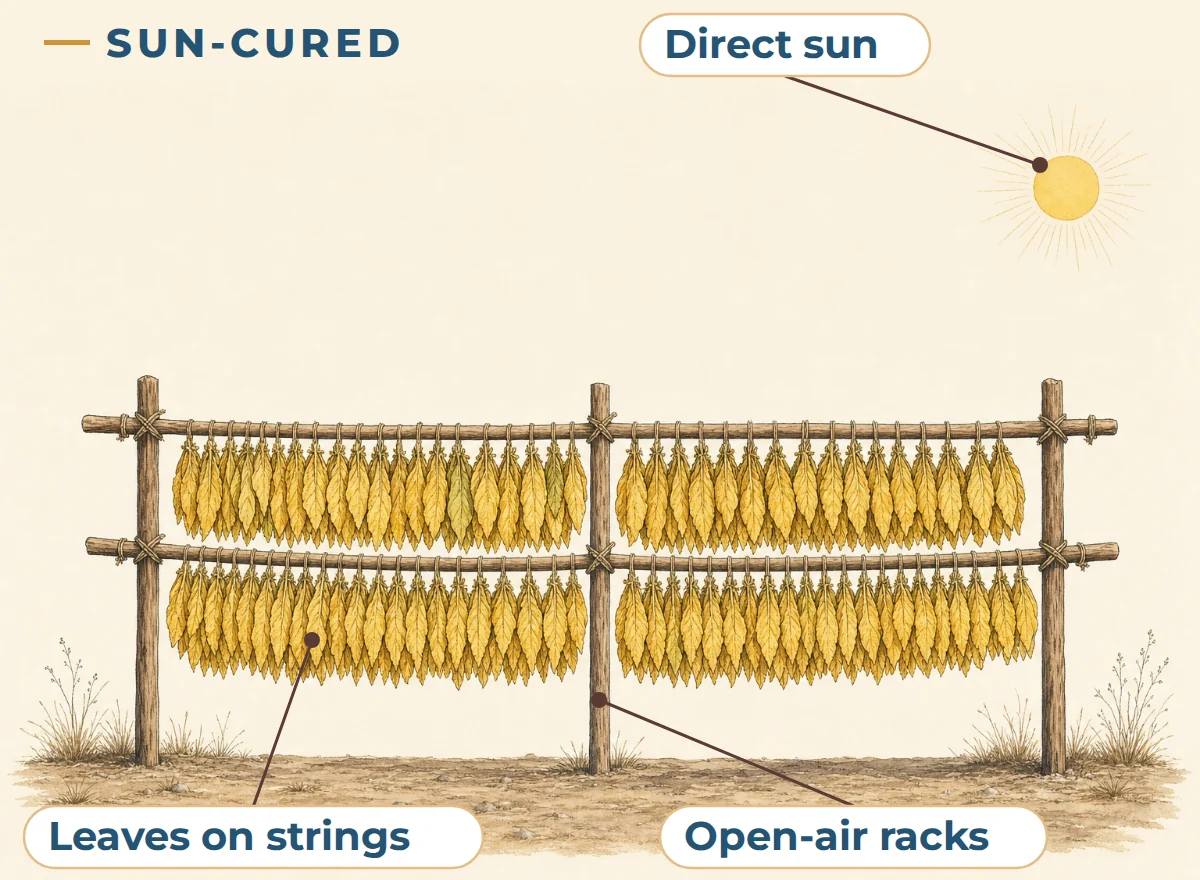
Its sugar content is where sources disagree, and it is worth saying so. The FDA review reports 10 to 20 percent for sun-cured Oriental. A 2023 field study of Greek oriental varieties measured between 2.71 and 9.78 percent across its growing sites. Both are real measurements. The honest summary is that Oriental sits between the sweetness of Virginia and the dryness of Burley, and exactly where depends on the variety, the region and the season.
Latakia, Perique and Cavendish: made in the process
Three of the best-known names in tobacco are not plant types at all. Each describes something done to leaf after it is grown.
Latakia is oriental leaf that has been smoke-cured over fires of aromatic wood and herbs. Trade sources name pine and oak among the woods. There is no Latakia plant; the smoke is what makes it Latakia. It is named for the Syrian port where it was historically produced, and pipe-tobacco trade sources say most of it is now made in Cyprus. The result is intensely smoky, with campfire and spice notes.
Perique grows in one place, St. James Parish, Louisiana, and the USDA gives it its own type number, 72. Bundles of leaf are packed into barrels and held under pressure while they ferment. According to the parish’s tourism commission, the leaf stays in the barrels for at least a year and is taken out, aired and turned by hand at least three times along the way. It is made in small amounts for specialty markets.
Cavendish is a method of preparing leaf, not a kind of tobacco. The leaf is pressed and treated with heat or steam, and it is often sweetened. The result is typically dark and mellow, and Cavendish is a staple of pipe tobacco.
Why the cure changes the taste
Curing changes flavor in two main ways. The first is sugar. Leaf that keeps its sugar tastes brighter and sweeter, and the FDA review notes that sugars left in the leaf can react with its natural nitrogen compounds through Maillard browning, the same family of reactions that browns bread crust, forming flavor compounds such as pyrazines. That review was written about smoke chemistry, so it explains the leaf rather than any single product made from it.
The second is smoke. Fire-cured leaf and Latakia carry the character of the fire that dried them, which no amount of sugar or blending can supply.
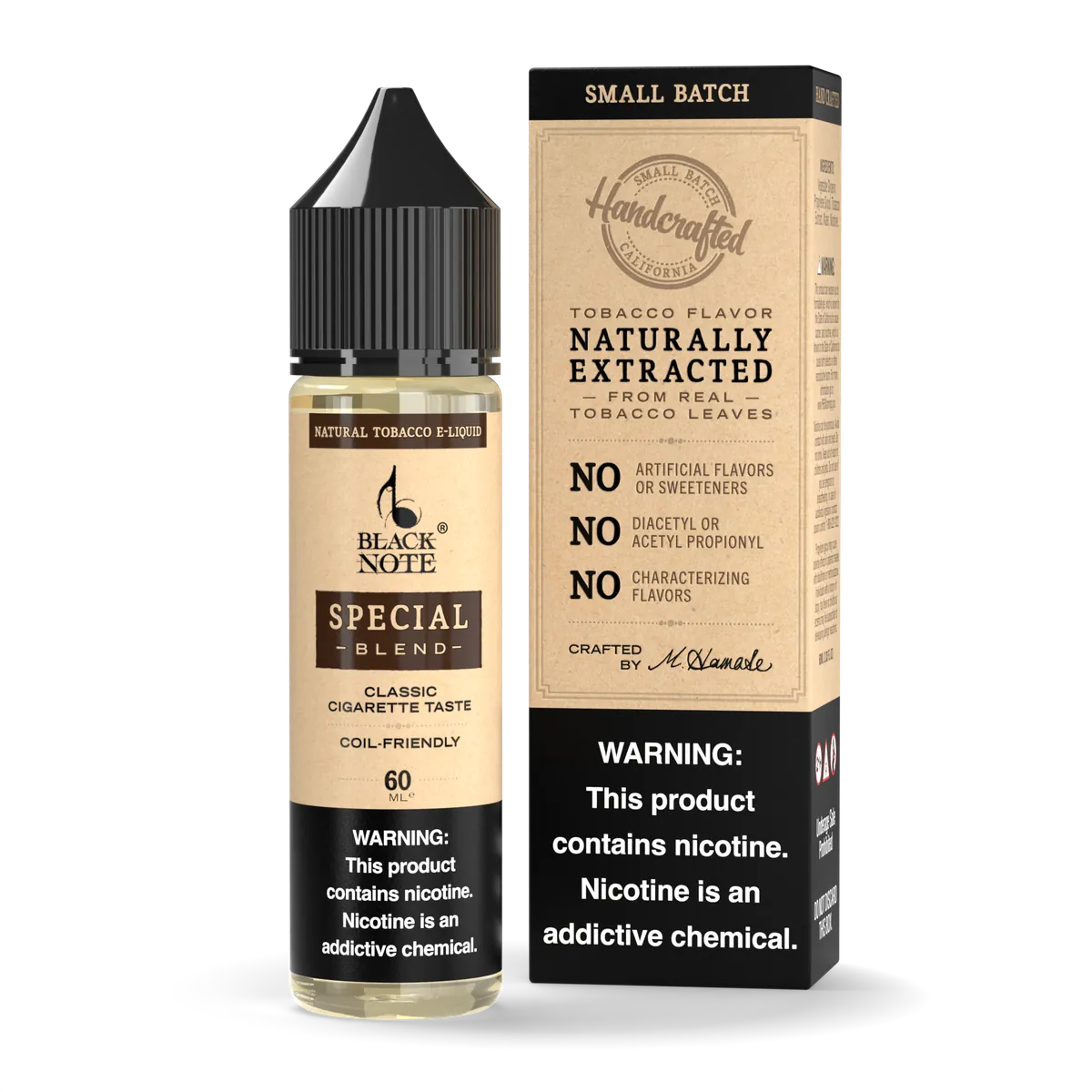
The same vocabulary appears on tobacco e-liquid labels. A naturally extracted tobacco e-liquid starts from real cured leaf, so a label that says flue-cured Virginia, air-cured Burley or fire-cured Kentucky is telling you which of the cures above that leaf went through. How the flavor is drawn out of the leaf is a separate subject, covered in our guide to naturally extracted tobacco.
Your next step
Taste what real tobacco leaf is like
Every Black Note blend is naturally extracted from real tobacco leaves. No artificial flavors, no sweeteners, no synthetic nicotine. Pick the tobacco profile, then your e-liquid type and strength, on the product page.
Want the source? Read the USDA classification of leaf tobacco.
Frequently asked questions
Sources
About this guide
WARNING: This product contains nicotine. Nicotine is an addictive chemical.
This guide is for adults 21 and older and is educational. It explains how leaf tobacco is classified and how the main curing methods change the leaf. It makes no health, safety or risk comparison of any kind, in any direction.
Government, university and peer-reviewed sources were retrieved and checked on September 22, 2026. Where a fact rests on a pipe-tobacco trade source, the sources list says so, and where published figures disagree, this guide gives both.
Stay connected with Black Note!
Subscribe to receive exclusive discounts, expert vaping tips, and updates on the latest devices directly to your inbox.