Is 20 mg salt nicotine the same as 20 mg freebase?
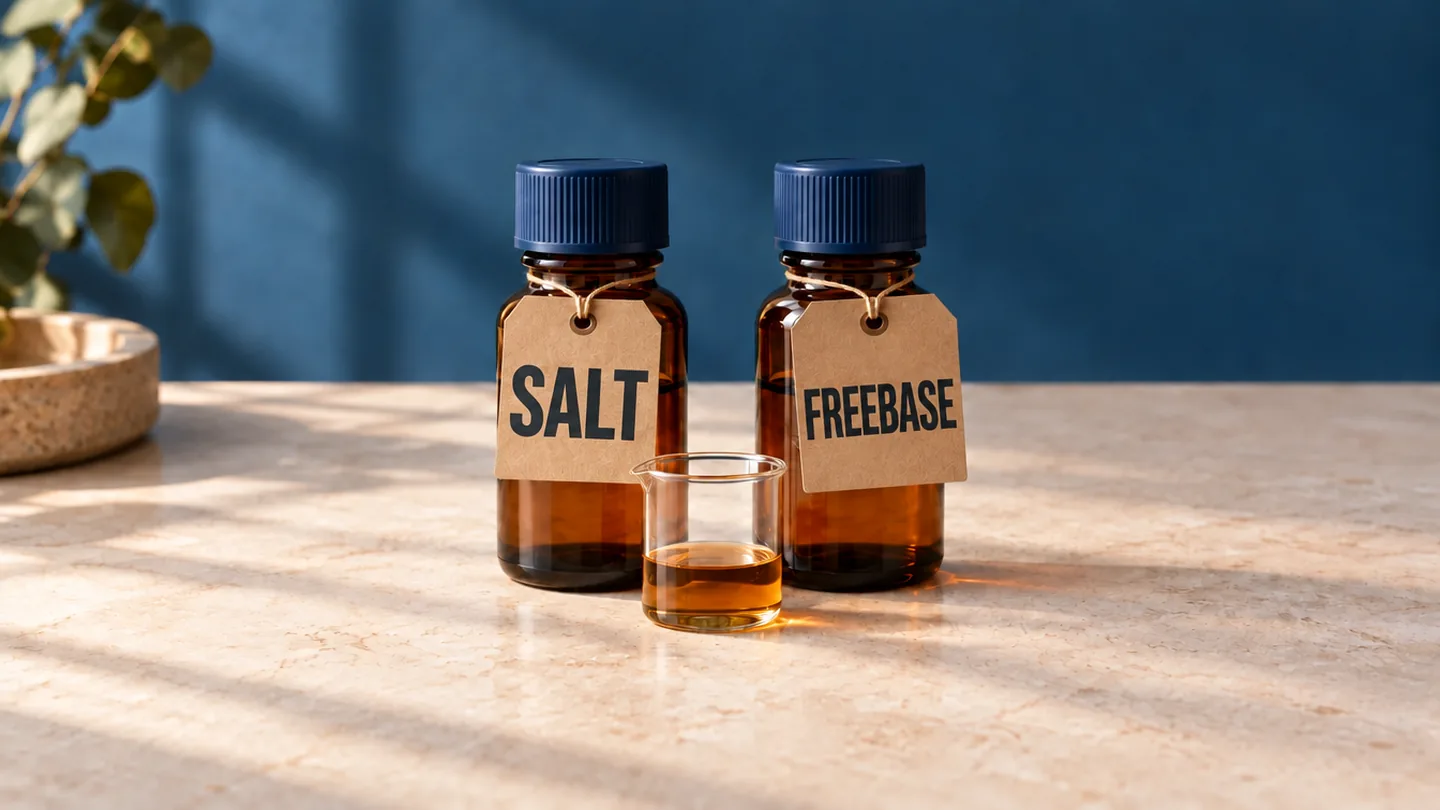
No. The milligram number tells you concentration, how much nicotine sits in each milliliter of liquid. It doesn’t tell you how much you’ll take in. Salt and freebase nicotine are the same molecule in two different chemical states, and once the liquid leaves the bottle they don’t behave the same way. Same number, same concentration. Not the same experience.
What the mg number actually measures
The number on an e-liquid label is a concentration. It says how much nicotine is dissolved in each milliliter of liquid, and nothing else.
A bottle marked 20 mg holds 20 milligrams of nicotine per milliliter. Some labels print that as a percentage, where 20 mg/mL is 2%. A 30 mL bottle at 20 mg/mL therefore contains 600 milligrams in total, because 20 times 30 is 600.
That is useful information, and it is also the limit of what the number does. Concentration is not a dose. It tells you what is in the bottle, not what ends up in you.
Three things sit between the label and you: what the device turns into vapor, how much of that vapor you inhale, and how much of the nicotine in it crosses into your blood. The label speaks to none of them.
Why this guide compares 20 to 20
Twenty is not an arbitrary pick. It is the strength the crossover trial further down actually tested, and it is a strength both forms are sold at.
It also avoids a comparison that cannot really be made. Low numbers like 3 mg and 6 mg are freebase territory. Salt nicotine is generally sold much stronger. On Black Note’s own catalog, checked September 20, 2026, the salt range is 20, 30 and 50 mg/mL while the freebase range stops at 18 mg/mL. The two ranges do not overlap at all, so asking whether 3 mg salt matches 3 mg freebase compares something you can buy against something you generally cannot.
One label trap follows from that. A small number on a salt bottle is usually a percentage, not milligrams. On that same catalog, 3% salt nicotine means 30 mg/mL, while 0.3% freebase means 3 mg/mL. Same digit on the label, ten times apart in the bottle.
Here is the same idea in about a minute, if you would rather watch it.
Salt and freebase are the same molecule
This is the part that gets garbled most often, so it is worth being precise. Nicotine salt is not a different substance from freebase nicotine. It is the same nicotine molecule carrying an extra proton. Manufacturers add an acid, the acid donates a proton to the nicotine, and the result is the protonated form the industry calls a salt. Freebase is the unprotonated form. One molecule, two chemical states.
That change lowers the liquid’s pH, which is why salt-based liquids are generally described as less harsh at higher concentrations. It does not create a new compound and it does not change where the nicotine came from.
Salt nicotine is not synthetic nicotine
These two get conflated constantly, and they are unrelated. Synthetic nicotine describes origin, made in a lab rather than extracted from a plant. Salt versus freebase describes chemical state. A salt can be tobacco-derived, and a freebase liquid can be synthetic.
Black Note’s own liquids show the distinction: the salt nicotine formulation of naturally extracted tobacco e-liquid uses the same tobacco-derived nicotine as the freebase versions, with no synthetic nicotine in any of them. The formulation changed. The source did not.
What the device sends out
Here is the first surprise. As far as the device is concerned, salt and freebase are interchangeable.
A 2020 study in Scientific Reports measured nicotine yield from an e-cigarette across a range of powers and liquid formulations, testing free-base against protonated nicotine directly. Its finding was blunt: “Nicotine yields were not influenced by nicotine form under any condition investigated.”
Two other variables mattered a great deal. The liquid vehicle was the larger one: at each power level tested, propylene glycol based liquids produced roughly double the nicotine yield of vegetable glycerin based liquids. Power was the other. Across the 5 to 45 watt range tested, raising the power raised the yield.
The practical consequence is awkward. Two bottles marked 20 mg, one a 50/50 blend and one a high-VG blend, can send meaningfully different amounts of nicotine out of the same device. At this stage of the chain, salt versus freebase is not the question that moves the number. Our guide to 50/50, 70/30 and salt e-liquids covers what those ratios mean in practice.
What reaches the bloodstream
If the device emits the same amount either way, the two bottles should land the same way too. They do not.
A 2024 randomized, double-blind, within-subject crossover study in Nicotine & Tobacco Research put 20 participants through three conditions and measured what reached their blood.
| Condition | Labeled concentration | Median peak plasma nicotine |
|---|---|---|
| Free-base | 20 mg/mL | 3.0 ng/mL |
| Nicotine salt | 20 mg/mL | 5.4 ng/mL |
| Nicotine salt | 40 mg/mL | 12.0 ng/mL |
The difference across the three conditions was statistically significant, at p less than .001. In the authors’ own words, the result was “nicotine salt resulting in 1.8-fold Cmax compared to nicotine free-base of the same concentration.”
Two caveats belong with that number. This is one study of 20 people on one device, not a general law of vaping. And the time taken to reach that peak was not significantly different between the forms, at p equals .059, so the salt was not faster in this trial. It was higher.
Why the reason is still argued
It would be tidy to stop there and say salt nicotine is simply absorbed better. The evidence does not let us.
A 2026 Scientific Reports paper pointed the opposite way. Working in vitro, with an aerosol model and simulated absorption solutions rather than people, it found that free-base nicotine moved into solution more readily than the protonated form. In water, the salt stayed on the filter pads at 1.54 times the rate per unit consumed, the signature of less absorption, not more. The authors describe their work as an in vitro basis for further evaluation rather than a finding about human uptake.
So the picture is unsettled. The device emits the same amount either way. The same labeled concentration produced roughly 1.8 times the peak blood level as a salt in a 20-person trial. A laboratory absorption model favors the free-base form.
The usual explanation is behavioral rather than chemical: because the protonated form is less harsh, people can draw on it more deeply and for longer, and so take more in. That is a reasonable hypothesis and it fits the evidence. It is not a finding, and nobody in these three papers demonstrated it.
Why no honest conversion table exists
Search for a salt-to-freebase conversion chart and you will find plenty. None can be right, and the reason is visible once the chain is laid out stage by stage.
-
What the label statesNicotine concentration per milliliter of liquid. Matching mg/mL labels state the same concentration, not the same amount absorbed.
-
What the device emitsNicotine carried in the aerosol. In the 2020 study, power and the liquid vehicle changed nicotine yield; nicotine form did not under the conditions tested.
-
What reaches the bloodstreamNicotine measured in blood after use. In the 2024 trial of 20 people, equal labeled concentrations produced different peak levels. That finding is not a universal conversion ratio.
A conversion chart has to compress stages 2 and 3 into one multiplier. It would need your device, coil resistance, power setting, PG and VG ratio, airflow, how long you draw and how often, plus a settled account of the absorption mechanism, which the previous section shows does not exist yet.
No chart carries that. When one hands you a clean number anyway, it has made every one of those decisions for you and not said which. The number on the bottle is real and useful, and it does not convert. Our nicotine strength guide and the broader salt versus freebase comparison go further.
A separate problem: the label may be wrong
Everything above assumes the number printed on the bottle is accurate. That assumption deserves a look of its own.
A 2021 systematic review in the Journal of the American Pharmacists Association pooled 20 studies that had bought refillable e-liquids and chemically analyzed them. Across 574 samples, 277 deviated by more than 10% from their own labeled nicotine concentration. That is 48.3%, close to half.
The spread between studies was wide, from 0% of samples out of tolerance to 100%, so this is not uniform and some products were exact. The review also found that samples bought in the United States deviated more often than those bought elsewhere.
That review is five years old and sampled products from around that time, so it is not a verdict on any bottle sold today. It is a reason to treat a printed milligram figure as a manufacturer’s stated value rather than a measured fact. What goes into a bottle is worth understanding on its own terms, which our guide to what vape juice is made of covers.
Frequently asked questions
Sources
About this guide
WARNING: This product contains nicotine. Nicotine is an addictive chemical.
This guide is for adults 21 and older and is educational. It explains what a measurement on an e-liquid label describes and what the current published research says about how two chemical forms of nicotine behave. It makes no health, safety or risk comparison of any kind, in any direction, and it does not recommend a nicotine strength to anyone.
All four studies cited were retrieved and checked against their published text on September 19, 2026. Figures are quoted as the authors reported them. Where the research disagrees, this guide says so rather than choosing a side.
Stay connected with Black Note!
Subscribe to receive exclusive discounts, expert vaping tips, and updates on the latest devices directly to your inbox.