How to Dispose of Vapes Safely: Devices, Pods, Batteries and E-Liquid

Take used vapes to a household hazardous waste collection site. Do not put them in household trash or recycling. That is the US Environmental Protection Agency’s guidance for individuals, and it applies to disposables, refillable devices, pods and leftover e-liquid. The reason is what is inside: a lithium battery that can catch fire when it is crushed, and nicotine, which is toxic.
This guide covers household disposal in the United States, part by part, with the source for each step. It also covers how to find a drop-off, how four real local programs differ, what to do with a leaking or damaged device, and the separate rules for vape shops, schools and workplaces. Local programs set their own terms, so confirm what yours accepts before you go.
Can you throw a vape in the trash?
No. EPA’s instruction is direct: do not put e-cigarettes in your household trash or recycling. A vape combines two hazards in one small device, and ordinary waste handling makes both worse.
- The battery. Lithium batteries can catch fire, especially when damaged. EPA notes that in trash and recycling bins they often get damaged by trash compactors and can cause fires during transportation and at waste and recycling facilities. In its guidance for schools and small businesses, EPA says most discarded lithium batteries would likely be considered ignitable and reactive hazardous waste.
- The nicotine. EPA describes nicotine as toxic, a risk to waste workers and harmful to fish and other aquatic life. The same guidance lists nicotine e-liquid as an acute hazardous waste under the federal Resource Conservation and Recovery Act (waste code P075). Liquid nicotine can also be absorbed through the skin, which is why leaking devices and leftover e-liquid need care. Our guide on what to do when vape liquid gets on your skin covers that.
How often do these batteries cause fires?
Often enough that EPA studied it. An EPA report on lithium-ion batteries in the waste stream found more than 240 fires caused by lithium-ion batteries at 64 waste facilities between 2013 and 2020. The most common sources it identified were batteries from small consumer devices, including cell phones, tablets, laptops, hoverboards and e-cigarettes. The report also recorded what those fires cost: injuries, disrupted recycling and waste service, monetary losses and emergency response.
Is it illegal to put a vape in the trash?
Under federal rules, waste e-cigarettes from a household count as household hazardous waste, which is exempt from hazardous waste regulation. EPA adds that most states exempt them too, while still strongly recommending a household hazardous waste site. So for most households this is a strong recommendation, not a federal penalty. Two caveats: your state, county or city can set stricter rules, and the exemption does not cover schools or businesses, which have to manage vapes under hazardous waste rules.
What is inside a vape, and why it matters
Every vape has the same basic parts, whatever it looks like. EPA’s description is that they all contain a lithium battery and are designed to vaporize nicotine e-liquid or other e-liquids held in a reservoir. It also notes that most e-cigarettes on the market are single use, and are not reusable or refillable.
| Part | What it is | Why it matters when you dispose of it |
|---|---|---|
| Lithium battery | Sealed inside disposables and most pod devices. Removable on many mods, which use cells such as the 18650 | Can catch fire when crushed or damaged. This is the reason for the trash and recycling rule |
| Nicotine e-liquid | The liquid in the pod, tank or bottle, including what is left when it looks empty | Toxic if swallowed or absorbed through the skin, and harmful to aquatic life. This is the reason for the drain rule |
| Pod, cartridge or tank | The container that holds the e-liquid and usually the coil | Keeps nicotine residue on its inner surfaces, so it follows the e-liquid rules until your program says otherwise |
| Housing | The plastic or metal body around the battery and e-liquid | EPA counts the plastic housing as a non-hazardous component, but on a sealed device it cannot be separated at home |
Because the battery and the nicotine sit side by side, a whole vape does not fit ordinary electronics recycling or ordinary trash. That is why the guidance sends it to a site set up for hazardous waste.
How to dispose of a vape, step by step
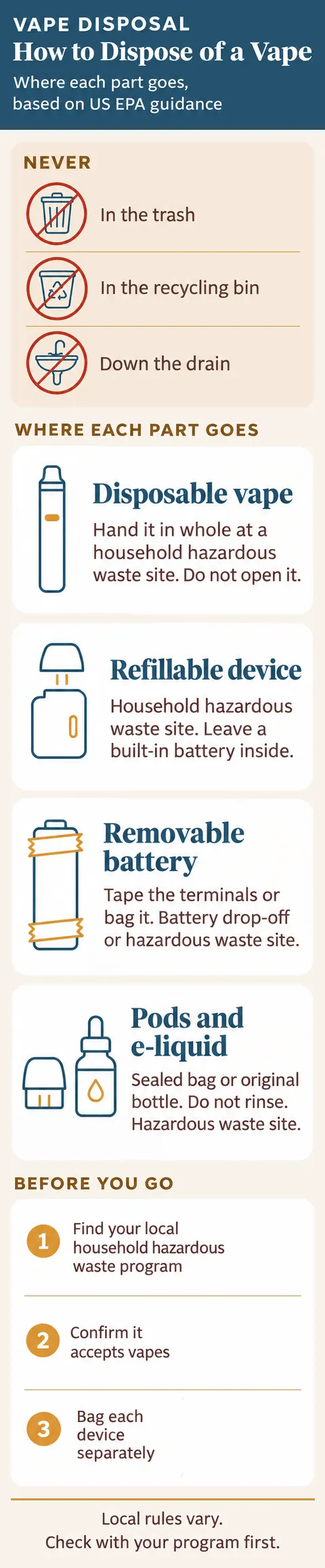
For a household, disposal comes down to six steps. The preparation steps come from EPA’s handling guidance for collected e-cigarettes and lithium-ion batteries.

-
Find your household hazardous waste programEPA’s household hazardous waste page suggests searching for household hazardous waste near your zip code in the Earth911 database, or contacting your local environmental, health or solid waste agency. Many communities run a permanent site, scheduled collection days or both.
-
Confirm it takes vapesEach program sets its own terms. Some accept vapes only at fixed sites, some cap how much you can bring, and some want batteries separated where possible. The questions to ask are listed below.
-
Switch it off and keep it in one pieceIf the device has a power button, make sure it is off. Do not pry open a device or pull out a battery or cartridge that is not designed to come out. EPA warns that trying to remove embedded batteries or cartridges can cause fires.
-
Bag each device separatelyEPA’s lithium-ion battery guidance is to place each device containing a battery in a separate plastic bag. Used pods and e-liquid bottles can share one sealed bag.
-
Store it out of reach until you goPoison Help advises keeping nicotine products out of reach of children, in their original packaging and in a locked container. Keep bagged devices away from pets too.
-
Drop it offTake the devices, pods and any leftover e-liquid to the site, and follow any preparation instructions the program gave you.
Questions to ask your program before you go
- Do you accept nicotine vapes, including whole devices with a built-in battery?
- Do you accept leftover e-liquid and used pods?
- Is there a limit per visit, and is there a fee?
- Which sites or collection days take vapes? Some programs accept them at fixed sites only.
- How do you want the items packed?
- Will you take a damaged or swollen device, or does that need a separate arrangement?
Where to dispose of vapes near you
Start with your city or county household hazardous waste program. These are the tools the official guidance points to.
- For whole vapes, pods and e-liquid: search for household hazardous waste near your zip code in the Earth911 database, or call your local environmental, health or solid waste agency. EPA says these collections are typically free for residents.
- For a removable battery on its own: EPA lists Earth911, The Battery Network (formerly Call2Recycle) and the Consumer Technology Association’s Greener Gadgets as places to find a battery recycling drop-off. EPA notes that it does not endorse these services.
How local rules differ: four real programs
The guidance says to confirm with your program because the terms really do vary. These four were checked on November 10, 2026.
| Program | Where vapes go | Limits and notes |
|---|---|---|
| King County, Washington | Fixed hazardous waste collection sites in Algona, North Seattle, South Seattle and Factoria | Not accepted at the traveling Wastemobile. Limit of 10 vape devices per trip. Empty nicotine cartridges can go in the regular trash |
| Clark County, Washington | Household hazardous waste sites at three county transfer stations, free for residents | Limit of 1 gallon of vape products per visit. A battery on its own can also go to a retail battery drop-off. Empty cartridges, tanks and bottles go in the garbage, not the recycling cart |
| San Francisco, California | The Recology household hazardous waste facility, its home collection service and listed drop-off sites | Do not remove built-in batteries. Damaged or swollen batteries are not accepted at standard drop-off sites; Recology arranges a free pickup instead |
| Alameda County, California | County household hazardous waste facilities, free drop-off | Asks for batteries to be separated where possible. Accepts tobacco vape liquid |
Two things stand out. Limits and accepted sites differ even between neighboring counties, and programs do not agree on empty pods and bottles, which is why this guide tells you to ask instead of giving one national rule.
What to do with each part of a vape
Each part of a vape has its own route. This table brings the guidance together for a US household.
| Item | Where it goes | What not to do |
|---|---|---|
| Disposable vape with the battery sealed inside | Household hazardous waste site, as a whole device | Open it, crush it, or put it in trash or recycling |
| Refillable device or mod at the end of its life | Household hazardous waste site. Remove the battery first only if it is designed to come out | Put it in trash or curbside recycling |
| Removable battery, such as an 18650 | A battery recycling drop-off or household hazardous waste site, with the terminals taped or the battery in its own bag | Carry it loose, or put it in trash or recycling |
| Used pods and cartridges with liquid or residue | Household hazardous waste site, in a sealed bag | Rinse them out |
| Leftover e-liquid | Household hazardous waste site, in its original labeled bottle | Pour it down a sink, toilet or drain |
| Empty pods, tanks and e-liquid bottles | Ask your local program. King County and Clark County both send empty cartridges to regular trash, and Clark County says to keep them out of recycling | Assume a recycling symbol means the item is accepted |
| Damaged, swollen or leaking device | Contact the manufacturer for handling instructions, and call your program before you bring it in | Assume a standard drop-off will take it |
How to dispose of disposable vapes
A disposable goes to a household hazardous waste site whole. Its battery is sealed inside and its pod still holds nicotine residue, so it carries both hazards in one piece, and neither part is meant to be separated at home. That includes disposables with a charging port: they can be recharged, but once the e-liquid is gone the whole device is still waste.
Why store battery bins usually will not take them
The Battery Network, formerly Call2Recycle, runs many of the battery collection boxes found in stores, and names The Home Depot and Lowe’s among its partnered retail collection sites. Its policy is that it does not accept disposable vapes or e-cigarettes unless the battery can be safely removed and fully separated from the device. If the battery cannot be removed, the device should not go in its collection boxes or drop-off sites. That rules out most sealed disposables. For those, it suggests checking with the manufacturer or retailer about take-back options.
California is phasing disposables out
California’s AB 762, signed in September 2026, bars the import and manufacture of disposable, battery-embedded vapor devices for sale in the state from January 1, 2027, and ends their sale and distribution on January 1, 2028. Under the law, a device counts as disposable if it cannot be refilled or cannot be recharged, so a device has to be both refillable and rechargeable to stay on sale. Disposables you already own still need to be handed in the same way.
The United Kingdom already has
For readers outside the US, the UK government’s guidance shows where the rules can go. Selling or supplying single-use vapes has been illegal there since June 1, 2025, and any business that sells vapes must offer a take-back service, accepting vapes and vape parts such as used pods, coils and batteries that customers return for recycling. In practice, a UK shop that sells vapes has to take used ones back.
How to dispose of vape batteries
Handle a battery separately only if it is designed to come out, such as the 18650 cells used in many mods. A built-in battery stays in the device and goes to the hazardous waste site with it.
- Protect the terminals. EPA advises placing non-conductive tape, such as electrical tape, over the battery’s terminals, or putting each battery in its own plastic bag, to prevent fires. The Battery Network adds that clear packing tape and duct tape also work, and that masking tape, painter’s tape and Scotch tape should be avoided because they can fall off.
- Use a battery drop-off or your HHW site. EPA points to specialized battery recyclers, retailers that take batteries back and local household hazardous waste programs. The Battery Network says all of its drop-off sites accept rechargeable batteries at the end of their life.
- Keep it out of trash and curbside recycling. EPA’s guidance is that lithium-ion batteries should not go in household garbage or recycling bins, where they can be crushed in transport or by sorting equipment.
Damaged, swollen or recalled batteries
These follow different rules, and most ordinary drop-offs will not take them.
- EPA’s advice for a damaged lithium-ion battery is to contact the battery or device manufacturer for specific handling information.
- The Battery Network says to isolate a damaged or defective battery immediately, place it in a non-flammable material such as sand or kitty litter, and never put it in the trash, water, home recycling bins or its collection boxes. Most of its drop-off locations do not accept these batteries. Trained locations that can are limited to Illinois, New York, Vermont and Washington, DC.
- Recalled batteries are not accepted at its collection sites. Contact the manufacturer and follow its instructions for disposal and replacement.
For handling batteries while they are still in use, see our vape battery safety tips.
How to dispose of vape juice and used pods
Leftover e-liquid and used pods go to the same household hazardous waste site as the device. The rules are about keeping nicotine out of water and off skin.
- Do not pour it out. EPA’s guidance for schools and small businesses says not to put nicotine e-liquids down the drain. The same reasoning holds at home: EPA notes that nicotine can harm fish and other aquatic life.
- Do not rinse pods or bottles. The same guidance says not to rinse or wash e-liquids out of e-cigarettes. Rinsing only moves the nicotine into the water.
- Keep it contained. Leave unwanted e-liquid in its original labeled bottle with the cap on. EPA’s general advice for household hazardous products is to keep them in their original containers and never remove the labels. Put used pods in a sealed bag.
- Protect your hands. EPA recommends chemical-resistant gloves, such as nitrile or latex, for people handling e-liquid waste, because nicotine is easily absorbed through the skin.
- Empty pods and bottles. Ask before you bin them. King County and Clark County both allow empty cartridges in regular trash, but your program may not.
- Nicotine-free e-liquid. The federal guidance above is written for nicotine products. Ask your local program how it wants nicotine-free leftovers handled.
What to do about leaks and spills
A leaking pod or bottle is a skin-contact risk first and a disposal job second. Poison Help, run by America’s Poison Centers, gives this first aid for liquid nicotine.
- On skin or clothing: remove any affected clothing and wash the area with soap and water.
- Swallowed or inhaled: contact Poison Help at 1-800-222-1222 for specific recommendations.
- Signs to watch for: Poison Help lists nausea, vomiting, headache, dizziness, pale skin, sweating, confusion, shakiness and a rapid heartbeat. It lists difficulty breathing, heart problems and seizures among the signs of severe poisoning. Treat those as an emergency.
Poison Help notes that most cases reported to poison centers are accidental exposures in children under six, which is the reason to bag leaking items and store them out of reach straight away. Once the spill is dealt with, seal the leaking pod or bottle in a bag and take it to your household hazardous waste site with the rest.
Vape shops, schools and workplaces follow different rules
The household route above does not apply to a business or school. EPA says e-cigarettes are hazardous waste under the Resource Conservation and Recovery Act when a school or business discards them, and it sets out three steps. This is a summary, not compliance advice, and state rules can be stricter.
-
Store collected devices safelyPlace each e-cigarette in its own clear, sealed plastic bag so the battery cannot short-circuit. Bag each loose lithium battery separately or tape its terminals. Nicotine vials, cartridges and pods can share one sealed bag. Wear chemical-resistant gloves if possible.
-
Work out your hazardous waste generator categoryCount all the hazardous waste the site generates in a calendar month, not only vapes. Nicotine e-liquid counts as acute hazardous waste, which has a low threshold of 1 kilogram (2.2 pounds). EPA’s examples of what exceeds it: more than 1,000 Juul pods, more than 76 Elf Bar devices at 13 milliliters each, or more than 200 full 5-milliliter vials. For batteries, it takes about 2,000 18650 cells to exceed the 100 kilogram threshold for non-acute waste.
-
Choose a disposal option for that categoryA very small quantity generator can use a locally run small business hazardous waste collection program, which is often located with the household site and usually charges a small fee. Larger generators follow the fuller hazardous waste rules.
EPA adds a warning about stockpiling: a site that accumulates more than 1 kilogram of acute hazardous waste can move into the large quantity generator category even if it generates less than that each month, so it recommends sending collected devices off site regularly. Its list of what not to do covers trash and recycling bins, drains, rinsing devices out, and taking them to Drug Enforcement Administration Take-Back Days.
A shop that wants to collect used vapes from customers has its own EPA tip sheet. Its main points: arrange a household hazardous waste facility or hazardous waste transporter before collecting anything, keep customer returns separate from the business’s own waste, do not remove embedded batteries or cartridges, and do not ship e-cigarettes by common carrier such as FedEx or UPS.
Common vape disposal advice, checked
A lot of vape disposal advice online conflicts with the official guidance. These are the claims we checked.
| The advice | What we found |
|---|---|
| It is called a disposable, so it goes in the trash | EPA says not to put e-cigarettes in household trash or recycling. |
| Take the battery out of a disposable and recycle it | EPA warns against removing batteries that are not designed to be easily removed, because it can cause fires. |
| Drop it in a store battery bin | The Battery Network does not accept vapes unless the battery can be safely removed and fully separated from the device. |
| Rinse the pods and recycle the plastic | EPA says not to rinse or wash e-liquids out of e-cigarettes. The two county programs we checked send empty cartridges to trash, not recycling. |
| Soak up e-liquid with cat litter or coffee grounds and bin it | We found no EPA guidance supporting this for nicotine e-liquid. EPA directs e-cigarette waste to household hazardous waste sites. |
| Bring vapes to a DEA Take-Back Day | It depends on where you live. EPA’s guidance for schools and small businesses lists this under what not to do, while Clark County, Washington, points residents to Take Back events for a device with the battery removed. Ask the organizer first. |
| Mail it to a recycler | EPA’s tip sheet for businesses that collect vapes says not to ship e-cigarettes by common carrier such as FedEx or UPS, and that transporting them calls for US Department of Transportation training, packaging and markings. |
What changes with a refillable device
A refillable device does not remove the disposal steps, but it changes what you hand in. With a disposable, the whole device, battery included, is discarded once the e-liquid runs out. With a refillable pod system, the same rechargeable battery stays in use while you refill it from a bottle and replace the pod or coil as it wears.
What you hand in over time looks different: used pods or coils and empty bottles as you go, and the device itself only at the end of its life. Each of those still follows the steps above, and the device still goes to a household hazardous waste site when it is finished.
If you are comparing the two, our guide to refillable alternatives to disposable vapes explains how the devices differ, and you can browse refillable pod systems here.
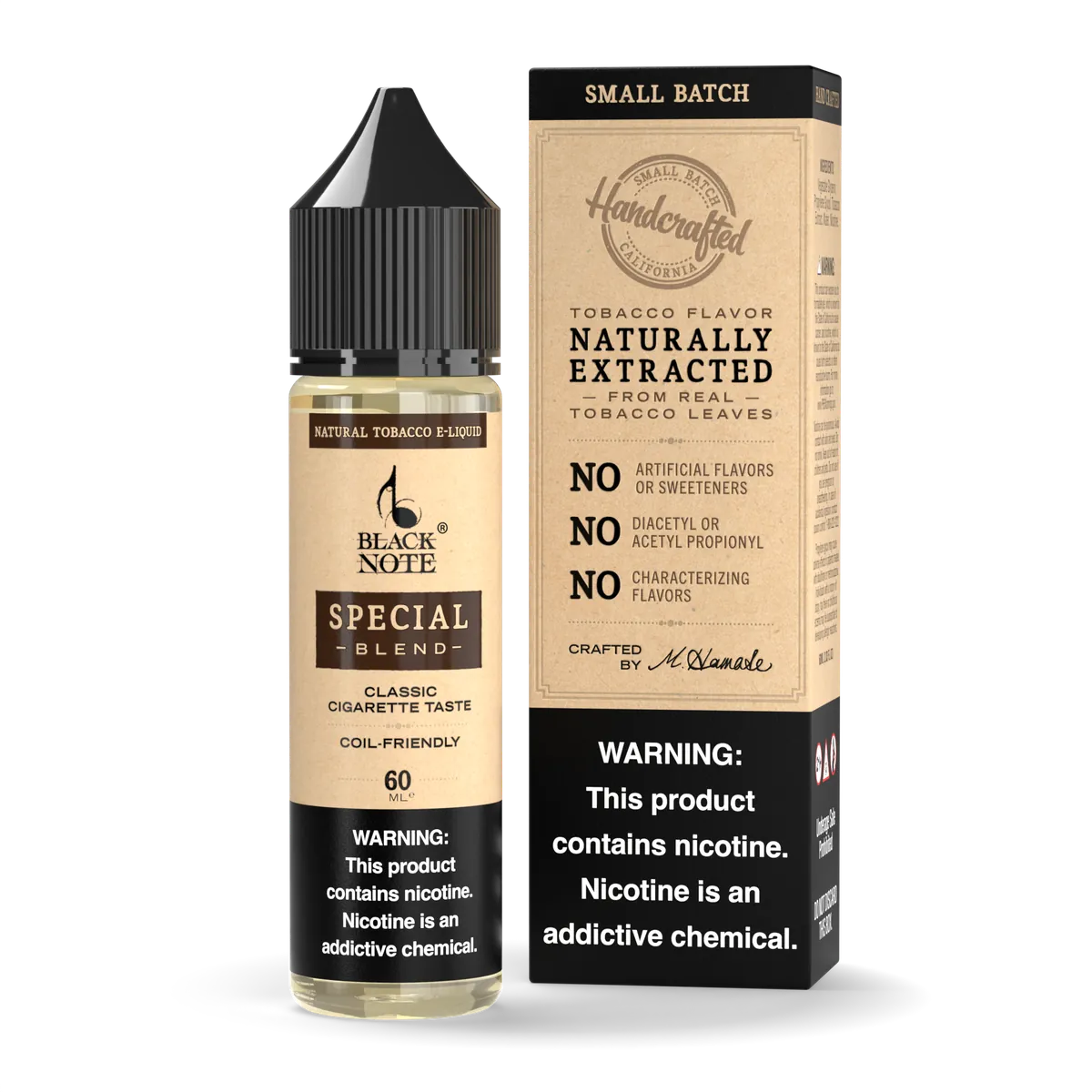
Refill with real tobacco flavor
Every Black Note blend is naturally extracted from real tobacco leaves, with no artificial flavors, no sweeteners and no synthetic nicotine. Choose a profile, from mellow Virginia to smoky Latakia or menthol.
Not sure which blend? Take the Vape Quiz.
Frequently asked questions
Sources
Stay connected with Black Note!
Subscribe to receive exclusive discounts, expert vaping tips, and updates on the latest devices directly to your inbox.